“Forget this man, he never existed”: Oscar winner Pavel Talankin on life after Mr. Nobody Against Putin
Six months ago a school videographer from a small Russian mining town won an Oscar. Eleven days later his film was banned in Russia. Pavel Talankin on the security service visit to his old school, the false story about his mother, starting again in Prague, and states that climb into people’s bedrooms.

Six months ago, a school videographer from a Russian mining town of 10,000 people walked on stage in Los Angeles to collect an Oscar. Eleven days later a Russian court banned his film, and the next day Moscow added him to its register of “foreign agents”. We talked to Pavel Talankin about what is left of that story now the spotlights are off: colleagues told to forget him, a mother wrongly reported as sacked, loneliness in a new country, and governments that climb into people’s bedrooms.
Interview by Evgeny Krinitsyn, a Russian journalist and author of the book How to Interview (Alpina, 2019). Translated from Russian and edited for clarity.
Pavel Talankin, 35, was born in Karabash in Russia’s Chelyabinsk region and worked as a school videographer. He made, and stars in, the Oscar-winning documentary Mr. Nobody Against Putin. He now lives in Prague.
“They declared me a foreign agent, and the film was banned. You couldn’t buy a better PR campaign if you tried.”
— Pavel Talankin
Who is Pavel Talankin?
Talankin was born on 11 March 1991 in Karabash, a copper-smelting town in the Urals often described as one of the most polluted places in Russia. He studied film and television directing at the Chelyabinsk State Institute of Culture, graduating in 2013, then went back to School No. 1 in Karabash as an events coordinator and its in-house videographer, filming every school event.
After Russia’s full-scale invasion of Ukraine in 2022, he was told to film “Conversations About Important Things”, the weekly patriotic lessons the Kremlin made compulsory in schools that autumn. Instead of just shooting the official clips, he spent two and a half years quietly recording how his school was turned into a tool of wartime propaganda. In June 2024 he left Russia with the footage on seven hard drives.
| Milestone | Date |
|---|---|
| Mr. Nobody Against Putin premieres at the Sundance Film Festival | January 2025 |
| Wins the BAFTA for best documentary | February 2026 |
| Wins the Oscar for best documentary feature | 15 March 2026 |
| A court in Chelyabinsk bans the film in Russia | 26 March 2026 |
| Russia’s Justice Ministry labels Talankin a “foreign agent” | 27 March 2026 |
| Two administrative cases against him go to court in Kyshtym, near his home town | September 2026 |
The film was co-directed by the American documentary maker David Borenstein. In Russia, the “foreign agent” label is a legal status the state uses against critics: it brings heavy reporting duties and makes it risky for others to work with the person. Talankin is on Instagram at @pashatalankin.
“I would have laughed in that person’s face”
— It’s been more than six months since the Oscars. Where are you living, and what does a normal day look like?
— Prague, in the Czech Republic. Mostly I’m showing the film: travelling, doing Q&As at festivals, discussions. That’s still what’s happening right now. I travel and I show the film.
— Is your diary full for a long time to come?
— No, that all wraps up for us in December.
— And then?
— Then I want to focus on languages, Czech and English. I don’t speak either.
— You’ve said there were times you woke up not knowing which country you were in. Have you got your bearings back?
— I’ve just flown in from the United States, a few weeks of pretty intense travel. In the past, if I’d been watching an interview and some jet-setter said, “Oh, flying is so exhausting,” I’d have laughed in their face. You just sit there and fly, what’s hard about that? But it really does wear you out. When it happens to you, it’s quite the adventure. And jet lag is brutal. I only learned that word recently, when I ran into it myself.
“Before, I would have laughed in that person’s face: you just sit there and fly, what’s hard about that? But it really wears you out.”
— Pavel Talankin
— Did you fly a lot?
— During the awards campaign, constantly. We had no money set aside for an Oscar campaign or for promoting the film, and we were up against giants like Netflix. So I had to travel and fly to meetings with sponsors who might donate to the film. They helped us enormously. But they wanted me there in person at the screenings.
“You couldn’t buy a better PR campaign”
— Eleven days after the Oscars the film was banned in Russia. How do people watch it there now, on pirate sites?
— Of course. And we pushed that ourselves. I kept asking myself: how do we get as many people in Russia as possible to see it? I even had the idea that we should somehow ban it in Russia ourselves, to spur interest. If people hear that this guy shot a film in Russia, went abroad, edited it there, and now it’s banned, they start asking what’s in it, and they go looking for it.
— And then you yourself were added to the foreign agents register.
— They declared me a foreign agent, and the film was banned. You’d struggle to find a better PR campaign. You couldn’t pull that off on the first try.
— Is there any data on how many people in Russia have seen it?
— There’s no data, so let’s not guess. In Russia there are no statistics on this at all.
— And outside Russia?
— I spoke to our producer yesterday. She said it has reached almost every country. The main audiences are the EU and the US, then South America and Australia, but I can’t say for sure. I don’t follow it.
“We undertake not to communicate with him”
— How have the people in the film reacted? Early on you said half turned away and half stood by you.
— With the teachers, things are strained, of course. You have to understand that Russian schools are almost entirely women, and that’s a much harder place to work, however undemocratic that sounds. And our teachers range in age: lots of older ones, lots in middle age, a few young ones. An older teacher can be a disaster, because they’re extremely sure of themselves and don’t tolerate mistakes from pupils or from young colleagues. Finding a supportive colleague who would mentor you just doesn’t happen in practice.
I wouldn’t say we were a close-knit staff. If I tried to count how many cliques it was split into, I’d lose track. But we had our own circle, the younger teachers. We hung out, met up on Fridays, talked about the news in a bar or at someone’s flat.
— And after the film came out?
— It got harder to stay in touch, because FSB officers came to the school and said: that’s it, forget this man, he never existed, and neither did the film. Nobody comments on it in any way. And it wasn’t just the school. They gathered everyone who works in education in the town. At the local children’s home, the director issued an order and every employee signed it: we undertake not to communicate with him. It’s got to the point where your employer tells you who you’re allowed to phone and who you’re not.
The FSB is Russia’s Federal Security Service, the main successor to the Soviet KGB.
“It’s got to the point where your employer tells you who you’re allowed to phone and who you’re not.”
— Pavel Talankin
— How did you find out?
— Only when people started leaving their jobs. They’d quit and say: right, now I can call you with a clear conscience and actually talk to you.
— What about your pupils?
— My students have all graduated now. They’re at university or working, some in good jobs. I’ve been in touch with them almost the whole time. We still have a group chat.
— Your mother worked at the school as a librarian. What happened to her?
— My mum still works at the school. After the film came out, a regional news site wrote that she had been forced to resign in disgrace and no longer worked there. She rang me and said: can you imagine, I go to work, open the website, and it says I don’t work here any more. She read it again to be sure. Why they wrote that, I have no idea. It’s an outright lie, and everyone in Karabash knows it. Everyone sees everyone there. It’s a big school, every pupil passes through the library, everyone collects their textbooks there.
— Are you still in touch with her?
— Yes, we spoke on the phone yesterday.
“That’s the sequel, and it’s being lost”
— If you were making the film now, would you do anything differently?
— If I could go back, and some voice from above told me, “Don’t worry, you’ll get all the hard drives out and nobody will notice,” then of course I’d shoot more. And I’d pay much more attention to the sound. It’s recorded terribly. I thought I was recording it well, but it turned out badly, because I had different recording sources and never synced them. That’s a nightmare in the edit. Very unprofessional.
— And overall? Are you happy with how it turned out?
— On the one hand, I’m glad we managed to make the film and show it to people, especially in Russia, especially in Karabash, and that it made such an impact. Because of the way people think in Russia: if I’d gone door to door with a flash drive saying, “Here, watch this, I made a film about us,” nobody would even have taken it. They’d say: yes, yes, sure, we’ll watch it. And it would sit on a shelf. But when you film it, leave the country and edit it abroad, suddenly it’s interesting. Everyone wants to see what came out of it.
“If I’d gone door to door with a flash drive, nobody would even have taken it. But when you film it and leave the country, suddenly it’s interesting.”
— Pavel Talankin
— And on the other hand?
— It’s a bit of a shame I had to leave so early. Things at the school and in the country didn’t stop, and what’s happening there now is the sequel to the film, and it’s being lost. Petrol stations are running dry. New laws for teachers: they now have to keep tabs on children who ask awkward questions in the “Conversations About Important Things” lessons. Pay has been recalculated in a completely different way. The town cut its budget for cancer patients, and that hits Karabash very hard. Lots of people there die of cancer. That support has more or less been shut down. People won’t even have enough for painkillers. A great deal has changed, and I’d like to document it.
— Have you thought about someone there carrying on and shooting the sequel?
— I’d be very glad if someone did. But I can’t openly say: come on, guys, keep going. That could count as incitement, and I could get them into trouble. I message one of my teachers, someone lets it slip, and that’s it, everyone’s in trouble. It’s each person’s own decision, a matter of conscience. Even just recording things is worth something.
— Did winning an Oscar give you a profession? Or are you still, in your head, a teacher from Karabash?
— Neither.
— What will you do after December, once the campaign for the film is over? Will you film something else?
— I can film, but… I don’t know. It’s a hard question. Don’t ask me that, I definitely won’t answer it.
“Some countries climb into your bed”
— Our site is about relationships and dating. It’s a very hard time for LGBTQ+ people in Russia right now. Did you ever date online there?
— No, never. For reasons that are obvious.
Since 2023 Russia has treated the “international LGBT movement” as extremist, and rights groups report that fake dating profiles are used to lure gay men into set-up meetings.
— And here in Europe?
— That’s a different question. There are countries that climb into your private life, right into your bed, to keep watch on you. And you have to understand: if a state behaves like that, there is something seriously wrong with it.
“There are countries that climb right into your bed to keep watch on you. If a state behaves like that, there is something seriously wrong with it.”
— Pavel Talankin
— Have you read about the fake dates used to entrap people?
— Yes, I came across an article quite recently. It’s a grim subject.
— So how do you make friends and meet people here?
— I don’t, really. There are some people I know. We met at an evening where people write letters to political prisoners, and we keep in touch. But we hardly ever see each other, because I’m always travelling. I’m not even thinking about that for now.
— It must be hard without the language. Is it only the Russian-speaking community?
— Yes. But that’s not why I want to learn languages. You just have to, you can’t get by without them. And with those friends, we rarely get together to talk. I go to see the producer, come home, and start packing for the next trip.
Meeting someone from an app? Our first date safety guide covers what to check before you go.
“You’ve more chance of driving a supercar than holding an Oscar”
— Where is the statuette, physically?
— At home. But I take it with me when I travel. I used to bring it as an optional extra. Now the producers write: don’t forget the Oscar. It’s compulsory now, because people love it. It’s something you’ve only ever seen on TV and can never touch. Go to a museum and nobody will put one in your hands.
— So you let people hold it?
— Yes. It’s not as if people normally hand their Oscar around so others can take photos with it. I’m starting to think I should charge a bit, because these days any AI will stitch you a photo in a second. But this way you hold it, you feel the weight, you see whether it sits well in the hand or not. We had a screening in New York, and some people from the film industry came up and said: honestly, we’ve more chance of getting into the most expensive car in the world and driving it than of holding a real Oscar.
“We’ve more chance of getting into the most expensive car in the world and driving it than of holding a real Oscar.”
— Pavel Talankin
— How many of your pupils do you think you kept out of the war?
— I don’t know how many, but I think there are some. A man wrote to me on Instagram: “Pasha, thank you so much for the film. It’s time I talked to my children about how propaganda works in school and what it actually is.” He said he just put the film on, they watched it and talked it through. And now, when the children come home from school, they tell him what happened that day.
Lots of people have done that. But what makes his message stand out is that it came from a man. Fathers in Russia are often cut off from raising their children: it’s the factory, work, home. Thousands of women did this, and one man wrote to tell me.
“Thousands of women did this, and one man wrote to tell me.”
— Pavel Talankin
Pavel Talankin is on Instagram at @pashatalankin.
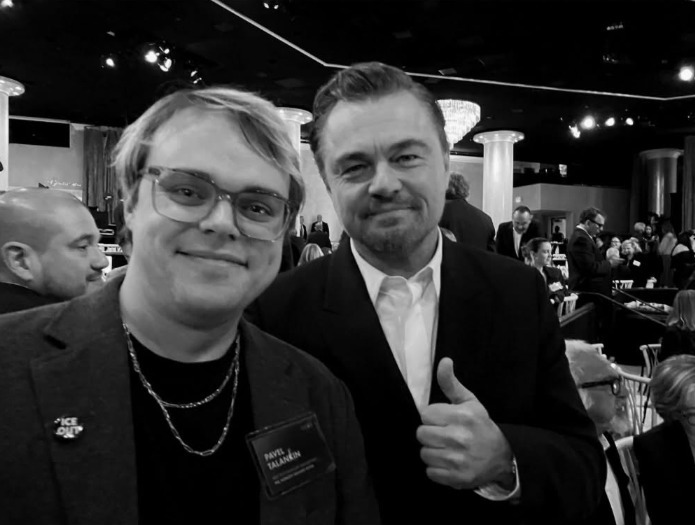
Cover photo: Pavel Talankin with Leonardo DiCaprio at the Oscar nominees’ luncheon, February 2026. Photo: Pavel Talankin