 DATING APP REVIEW
Tinder review 2026: the original swipe app tries to grow up
Tinder still has the biggest crowd in the room. In 2026 it is spending heavily on safety, AI matching and real-world events to make that crowd feel less like a queue.
Our score
Best for Casual dating and the widest choice
- Store rating
- 3.9 (Google Play UK, 19 Oct 2026)
- Free version
- Yes
- Paid from
- £3.99 (Tinder Plus, UK App Store; duration not stated)
- Platforms
- iOS, Android
- Owner
- Match Group
- Verification
- Photo Verified via Face Check video selfie (mandatory in select markets)
- Paid tiers
- Tinder Plus, Gold, Platinum
- App Store rating (UK)
- 4.2 from 274k ratings (19 Oct 2026)
Pros
- Largest user base: 55 billion-plus matches across 190 countries
- Mandatory Face Check in a growing list of markets, with measurable results
- Modes (Double Date, Music, Astrology) and Events add ways to meet beyond the swipe
- Cheap entry tier in the UK
Cons
- Still swipe-first, so quality varies widely
- Chemistry's camera-roll analysis raises genuine privacy questions
- Many new features are pilots limited to certain cities or countries
- Paid tiers stack up quickly once you add Boosts and Super Likes
Inside the Tinder app: screens from the App Store

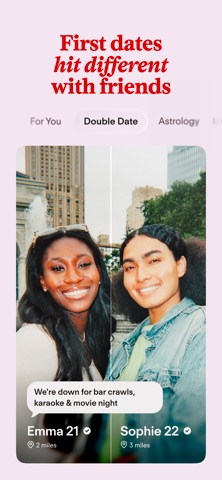
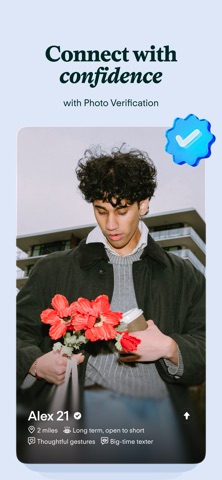
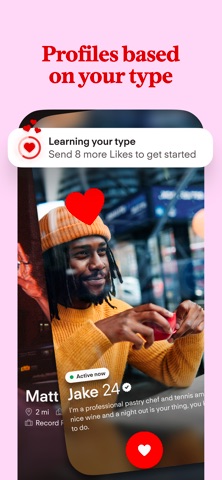
Tinder’s homepage carries a number that no rival can touch: more than 55 billion matches, in 190 countries. Its tagline, “It starts with a swipe”, is still there too. But in 2026 Tinder has spent most of its energy on everything that happens around the swipe: a mandatory face scan for new users in a growing number of countries, an AI layer called Chemistry, themed Modes, in-person Events and, in July, its first full rebrand in nearly a decade.
The reason is visible in Match Group’s figures. Tinder’s daily active users fell 4% year on year in the second quarter, which the company described as the narrowest decline in ten quarters, according to Match Group’s Q2 2026 results. A slower decline is still a decline, and Tinder knows it needs to give people new reasons to open the app.
Our verdict on Tinder
Tinder remains the app with the most choice, and for casual dating, new cities or simply meeting a lot of people, that scale is hard to beat. Its 2025–26 safety work is genuinely impressive: Face Check has, by Match Group’s account, cut exposure to bad actors by more than 60% where it runs. The new Modes and Events are a smart attempt to make the app feel social rather than transactional.
What holds it back is the core mechanic. Swiping on a huge pool is fast and fun, but it rewards photos over substance, and many of the more interesting 2026 features are still pilots in particular cities. Chemistry’s optional camera-roll scan also asks for a level of access we would think hard about granting. On balance, we rate Tinder 8.8: the best big-pool app, though not the most thoughtful one.
How Tinder works in 2026
The basics are unchanged. You build a profile with photos, interests and prompts, set your preferences, then swipe right to like or left to pass. A mutual right swipe makes a match and opens the chat. You can also set Relationship Goals to signal if you want something long-term or casual, and use Passport to match with people in another location, according to Tinder’s site.
The App Store listing describes a few more recent additions: matching with people nearby or further afield, answering prompts to show personality, going on Double Dates with a friend, and sharing your date plans with someone for safety.
Modes, Events and the Sparks overhaul
In March 2026 Tinder held its first product keynote, Sparks 2026, in Los Angeles, and announced more than ten new features, according to Mediaweek. Among them:
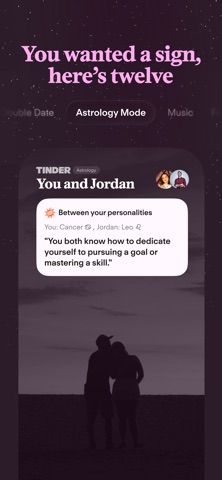
- Modes expanded globally. Music Mode was redesigned around shared listening taste, building on the Spotify integration, and Astrology Mode lets you add Sun, Moon and Rising signs. Tinder said women sent nearly 20% more likes to astrology-enabled profiles in early testing.
- Double Date lets you team up with a friend and go on dates as a pair.
- Events, a beta that lets you browse local activities such as trivia nights and pottery classes and see which singles are going. By Q2, Match Group said Events had expanded to further US and European cities, with a target of 26 cities by the end of September; in the Los Angeles pilot, 71% of eligible users aged 18–24 engaged with the Events tab.
- Video speed dating, three-minute live video chats for photo-verified users, was announced for testing later in 2026.
- Tinder Connect integrations with Duolingo and Beli, alongside Spotify, plus a profile redesign with fuller photos.
Match Group chief executive Spencer Rascoff, who also runs Tinder, said at the keynote that more than half of Tinder’s users are under 30. The Gen Z dating shift explains much of this: younger users want lower-pressure, group and in-person options, and Tinder is building toward them.
A new look
In July 2026 Tinder unveiled a rebrand by the New York agency Porto Rocha, its first in nearly a decade. According to Creative Review, it brings a bolder all-caps wordmark, a sharper redrawn flame, blue and green alongside the familiar red-to-pink gradient, and a tone of voice guided by a fictional dating columnist called “T”. Cosmetic, yes, but a signal that the company wants Tinder to feel less like a 2014 hook-up app.
Tinder profiles and matching: Chemistry and AI recommendations
Chemistry is the most ambitious, and most contentious, of Tinder’s 2026 features. Mediaweek described it as an AI recommendation layer that serves a small number of curated daily matches based on personality signals, preferences and optional image analysis, intended to reduce swipe fatigue.
The image analysis is the sticking point. When Match Group first disclosed Chemistry in November 2025, it was piloting in New Zealand and Australia and involved an opt-in scan of users’ camera rolls to learn about their interests, SAN reported. Access requires your permission, but critics pointed out that camera rolls can contain sensitive material such as screenshots of private conversations, and at the time Tinder had not published retention details for the feature. Our advice: if Chemistry asks for camera-roll access, read exactly what it will process before you tap allow.
Tinder’s Learning Mode, also expanded this year, adjusts recommendations in real time based on how you use the app. For a wider look at these tools, see our research on AI in dating.
Tinder pricing: Plus, Gold and Platinum explained
Tinder is free to use: you can swipe, match and message without paying. According to Tinder’s help centre, the three subscriptions break down as follows.
Tinder Plus – Unlimited daily likes – Unlimited Rewinds (take back your last Like or Nope) – Passport mode for any location – No adverts – Incognito, to hide your profile at any time
Tinder Gold (everything in Plus, plus) – Weekly Super Likes – A monthly Boost, making you a top profile in your area for 30 minutes – See who likes you before you swipe
Tinder Platinum (everything in Gold, plus) – Prioritised Likes, so your Likes and Super Likes are seen sooner
The help centre adds some fine print: monthly Boosts aren’t included on weekly subscriptions, some features may be withheld from some subscribers during testing, and some Plus subscribers may still see ads.
On prices, the UK App Store on 19 October 2026 listed Tinder Plus at £3.99 and Tinder Gold items at £7.49, £11.99, £13.99 and £14.99. Single Boosts were listed at £3.99 and £7.99, three Boosts at £9.99 and five Super Likes at £4.99. Platinum wasn’t itemised with a price on the listing, and the listing doesn’t say which duration each price covers, so check the in-app screen for your plan.
Which Tinder tier is worth it?
For most people, Gold is the meaningful upgrade, because “see who likes you” removes much of the guesswork. Plus mainly suits people who travel (Passport) or want to remove ads. Platinum’s prioritised likes are a visibility play; in a pool this large that has some value, but it is the hardest tier to justify on paper.
Is Tinder safe? Face Check, verification and chat tools
Tinder’s safety record has improved markedly, and Face Check is the centrepiece. New users record a short video selfie, which is checked for liveness and compared with their profile photos; those who pass get a Photo Verified badge. The system also detects the same face being used across multiple accounts.
When Match Group expanded it across the US in October 2025, it said the Face Check rollout had brought a more than 60% fall in exposure to potential bad actors and a more than 40% fall in reports about them, measured alongside other safety initiatives. The video selfie is deleted shortly after review; an encrypted, non-reversible face map and face vector are kept to verify new photos and catch duplicate accounts.
In the UK, Tinder said in March 2026 that all new sign-ups would be required to complete Face Check, TechTimes reported, linking the move to tighter identity and age expectations under the Online Safety Act. Tinder’s homepage lists Face Check as available in select markets.
Other tools: – Share My Date, to send your plans to a friend – Are You Sure?, now LLM-powered, which flags harmful messages before they’re sent – Does This Bother You?, which now blurs potentially disrespectful messages automatically – Block, unmatch and report
Our romance scam statistics guide explains why these protections matter on large, open platforms in particular.
Who Tinder suits (and who should skip it)
Tinder suits people who want choice and pace: anyone new to a city, travelling (with Passport), or happy to date casually and see where it goes. Its sheer scale also helps if you live somewhere with fewer singles. The Modes and Events add a social dimension that makes it more fun than it was a few years ago, especially for under-30s.
Skip it if you want depth from the first interaction. Profiles are photo-led and matches can be thin; if you want prompts that spark conversation, Hinge is a better fit. Be cautious, too, if you are uncomfortable with AI analysing your photos.
Tinder’s published ratings remain solid. On 19 October 2026 it held 4.2 out of 5 from 274,000 ratings on the UK App Store, and 3.9 from about 9.19 million reviews on Google Play in the UK, where it has more than 500 million downloads.
Tinder alternatives to compare
- Hinge: prompt-led and relationship-focused, our highest-rated app. Read our Hinge review.
- Bumble: strong safety tools, mid-way through a major redesign. See our Bumble review.
- Match: a more mature, search-based service. Our Match review has the details.
- eharmony: compatibility matching for long-term intent. See our eharmony review.
The complete ranking is in our best dating apps guide.
Frequently asked questions
Is Tinder free?
Yes. You can swipe, match and message without paying. Tinder Plus, Gold and Platinum are optional subscriptions that add unlimited likes, see-who-likes-you and prioritised likes respectively.
What is the difference between Tinder Gold and Platinum?
Gold adds weekly Super Likes, a monthly Boost and the ability to see who likes you. Platinum includes all of that plus Prioritised Likes, which means your Likes and Super Likes are seen sooner.
Is Face Check mandatory on Tinder?
It is mandatory for new users in a number of markets, including the US and, according to Tinder’s March 2026 announcement, the UK. Tinder lists it as available in select markets.
What is Tinder Chemistry?
Chemistry is an AI feature that serves a smaller set of curated daily matches based on personality signals and preferences, with optional analysis of photos from your camera roll if you grant permission.
Who owns Tinder?
Tinder is owned by Match Group, which also owns Hinge, Match, OkCupid, Plenty of Fish and other dating brands.