 DATING APP REVIEW
HER review 2026: the sapphic dating app, now under Match Group
HER was built by and for queer women, non-binary and trans people, and it still feels like it. Since May 2025 it has belonged to Match Group, and the question is what changes next.
Our score
Best for Queer women, non-binary and trans sapphic daters
- Store rating
- 3.3 (Google Play UK, 19 Oct 2026)
- Free version
- Yes, with ads
- Paid from
- £13.99 (HER Premium, UK App Store; duration not stated)
- Platforms
- iOS, Android
- Owner
- Match Group (acquired May 2025)
- Verification
- Optional social media account linking
- Paid tiers
- HER Premium, HER Platinum
- Founded
- Launched 2013 as Dattch; renamed HER in 2015
Pros
- Built specifically for lesbian, bi, queer, non-binary and trans sapphic people
- Detailed identity fields and filterable Pride Pins
- Communities and local events make it as much social as dating
- Core matching and chat free
Cons
- Google Play rating of 3.3 in the UK trails the App Store's 4.3
- Verification relies on linking social accounts, not a selfie check
- App Store labels list location among data used to track you
- Match Group ownership worries some long-time members
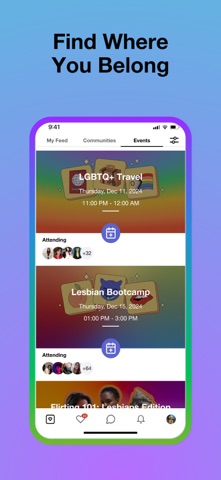
Inside the HER app: screens from the App Store
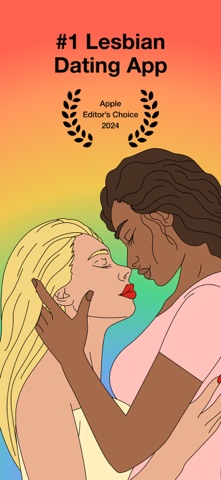
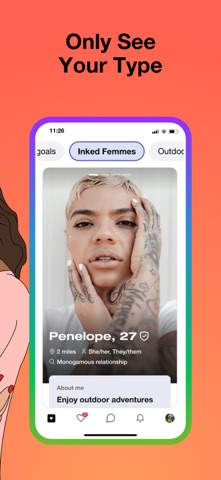
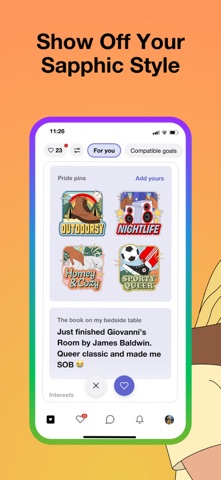
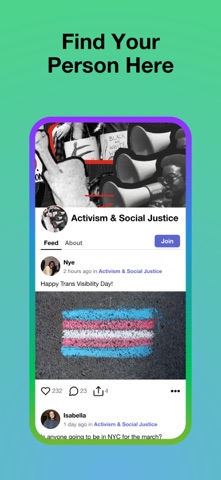
When Robyn Exton announced in May 2025 that HER had been bought by Match Group, the comments on her post were, MediaPost reported, largely sceptical. Several readers pointed to what they saw as OkCupid’s decline after Match acquired it. Exton’s reassurance was simple: HER was “still going to be the same app”.
Seventeen months on, that promise is the lens through which any review of HER has to be read. The app Exton launched in 2013 as Dattch, renamed HER in 2015 according to its Wikipedia history, remains the best-known dating and community app for lesbian, bi, queer, non-binary and trans sapphic people. It now sits inside the same corporate family as Tinder and Hinge.
Our HER verdict
HER scores 8.1 because it gives queer women and non-binary people something general apps cannot: a space where nobody needs to explain who they are, and where community features sit alongside dating. Identity fields are detailed, Pride Pins let you signal and filter on what matters, and communities and events give the app a social life beyond matching.
What holds it back is a weaker safety toolkit than its new stablemates, with verification still based on linking social media rather than a selfie check, and Android reviews that are noticeably cooler than iPhone ones. Match’s ownership could bring the investment in fraud prevention Exton has said HER needs. In our assessment, HER remains the first app to try for sapphic dating, especially outside the biggest cities, but it is worth watching how the next year unfolds.
How HER works: dating, community and events
HER’s homepage describes the app as being for queer women, non-binary people and trans people, and calls it “the #1 LGBTQIA+ dating app”. It claims more than 15 million active members and over 300 million matches across roughly eight years. The UK App Store listing gives a lower figure, “over 13 million users”. Both are company claims, and the gap between them is a useful reminder to treat headline numbers with care.
There are three strands to the app.
Dating. You browse nearby profiles, like or pass, and match when the feeling is mutual. The App Store listing says free members can match and chat with people nearby and globally.
Communities. HER hosts topic-based communities, more than 30 according to the App Store and more than 35 according to the homepage, where members post and talk outside one-to-one matching. Profiles include an “Add Friend” option, a small signal that the app is happy to be used for friendship as well as romance.
Events. The app lists local queer events and activities, and the homepage presents events as a way to meet people in person rather than through messages alone.
That mix is HER’s real distinction. For people in smaller towns, where the dating pool on a sapphic app may be thin, communities and friend-making can make the app worth opening when there is nobody new to swipe.
Profiles, identities and Pride Pins
HER profiles go further than most on identity. The homepage lists pronouns, gender identity, sexual orientation and lifestyle details, plus optional “Pride Pins” and “Political Pride Pins” that members can display and use to filter. Premium adds a filter by sexuality.
The language is the point. A general-audience app may offer a long list of identities, but HER is designed around them, and the defaults assume a sapphic audience rather than treating it as a sub-category. Local language support covers English, Spanish, French, German and Japanese, according to the homepage.
Making a HER profile work harder
Because the pool on a sapphic app is smaller than on a mass-market one, the profile has to do more of the work. In our assessment, three choices matter most. First, fill in the identity and pronoun fields rather than leaving them for the conversation; on HER they are the point, not an afterthought, and they power other people’s filters. Second, use Pride Pins sparingly and honestly, since a profile with a dozen pins says less than one with three that genuinely reflect you. Third, join a few communities early. Posting and replying in a group gives people a sense of your voice before they ever see your photos, which suits anyone who finds cold openers excruciating.
Linking a social account for verification is a judgement call. It adds trust, and verified-only filters mean some members will never see an unverified profile. But it also ties your dating life to another online identity, which may not be wise if you are not out to everyone in your life.
How matching works
Matching itself is straightforward and not driven by questionnaires. If you want detailed compatibility scoring, OkCupid does that better. HER’s strength is the context around a match, not the maths behind it.
HER pricing: what Premium and Platinum include
HER’s homepage says core features are free “permanently”. The free tier covers profile building, matching, chatting and communities.
HER Premium, according to the homepage, adds:
- An ad-free experience
- Incognito mode
- Rewind for accidental swipes
- Seeing who has viewed or liked you
- Seeing who is online in real time
- Filtering by sexuality
- Unlimited swipes
The App Store and Google Play descriptions also mention extra search filters and an “Online now” feature for sending real-time greetings.
What HER costs in the UK
On the UK App Store, checked on 19 October 2026, “Her Premium” was listed at £13.99, and a series of “Her Platinum” purchases ranged from £15.99 to £24.99. Apple does not label plan lengths. The App Store description says Premium starts at US$14.99 a month, with prices varying by region. HER does not publicly set out what Platinum adds over Premium in the sources we could access, so we have not described it here.
Is the free version enough?
For browsing communities and chatting with matches, yes. The main frustrations for free users are advertising and not knowing who has already liked you. In a smaller dating pool, Premium’s “who liked you” view is arguably more valuable than on a mass-market app, because each potential match counts for more.
Is HER safe? Verification, moderation and privacy
Verification and moderation
HER’s homepage says members can verify their profiles by connecting social media accounts, and encourages others to filter for verified profiles. That is a lighter-touch approach than the selfie or video checks now standard on Hinge, Bumble and Plenty of Fish, and it relies on members being willing to link another account, which not everyone in the queer community will want to do.
The same page says a trust and safety team, including moderators, works continuously, that members can flag or report content, and that the team removes scammers, transphobic users and fake celebrity profiles. HER links to safety guidance for meeting people, but it does not publish moderation statistics in the pages we reviewed.
Fraud is the issue to watch. Speaking at the time of the acquisition, Exton said, as quoted by MediaPost: “To maintain a higher level of protection, we need larger teams focused on fraud prevention.” Match’s scale should help with that. Whether it does is the most important test of the deal.
Privacy considerations
The UK App Store privacy labels, supplied by the developer, list purchases, location, contact info, identifiers and usage data as data that may be used to track you across other companies’ apps and websites. Data linked to you also includes user content and sensitive information. Location appearing in the tracking category deserves attention on an LGBTQ+ app, and members who are not out, or who live or travel in hostile environments, should review permissions and keep identifying details out of public profiles and community posts.
What users say
As of 19 October 2026, HER held 4.3 from about 6,700 ratings on the UK App Store, and 3.3 from about 74,500 reviews on Google Play in the UK, where it has passed five million downloads. That gap between iPhone and Android users is wide and consistent with complaints about ads and paywalls elsewhere in the market.
HER and Match Group: what the acquisition means
Match Group’s corporate site now lists HER in its portfolio alongside Tinder, Hinge, OkCupid and Plenty of Fish. The company’s annual report groups it among “affinity-based brands”, which “serve communities defined by shared culture, values, or experiences”, within the Evergreen & Emerging division. No financial terms were disclosed, according to Bloomberg.
At the time, Match chief executive Spencer Rascoff called HER “a home, a movement, and a mirror for millions”, and said, according to Global Dating Insights, that Match’s role was to support the app rather than redefine it. Exton said the deal would let the team “launch new features faster”.
For users, the practical implications are mixed. Bigger trust and safety resources would be welcome. The worry, voiced in those early comments, is the pressure on independent-minded apps to monetise more aggressively once inside a large group. HER’s free tier remains generous for now.
Who HER suits, and who should skip it
It suits lesbian, bi, queer, non-binary and trans sapphic people who want a dedicated space rather than a filter setting on a general app. It suits people who value community and friendship as much as dating, and those new to queer dating who want lower-pressure ways to meet people.
It also suits daters in smaller cities, where communities and events can make up for a thinner pool.
Skip it if you want rigorous identity verification as standard; at present, HER relies on social account linking. Skip it if you prefer independent, founder-owned apps on principle, since HER is now part of Match Group. And if you are exploring non-monogamy as part of a couple, Feeld has better tools.
HER alternatives
For a mainstream app with a large LGBTQ+ user base and detailed identity options, see our OkCupid review. Our Hinge review covers a relationship-first alternative with stronger verification. Queer people interested in open relationships should read our Feeld review. And our full ranking of the best dating apps compares all ten.
Frequently asked questions
Is HER free?
Yes. You can create a profile, match, chat and join communities without paying. HER Premium removes ads and adds incognito, rewind, unlimited swipes and the ability to see who has viewed or liked you.
Who can use HER?
HER says it is for queer women, non-binary people and trans people. It is aimed at the lesbian, bi, queer and wider sapphic community.
Who owns HER?
Match Group acquired HER in May 2025. The app was founded by Robyn Exton, who launched it as Dattch in 2013 before renaming it HER in 2015.
How does HER verification work?
According to the HER website, members verify their profiles by connecting social media accounts, and other users can filter for verified profiles. It does not currently describe a selfie or ID check.
How much does HER Premium cost in the UK?
On the UK App Store in October 2026, HER Premium was listed at £13.99, with HER Platinum options from £15.99 to £24.99. Prices vary by region and plan length.